
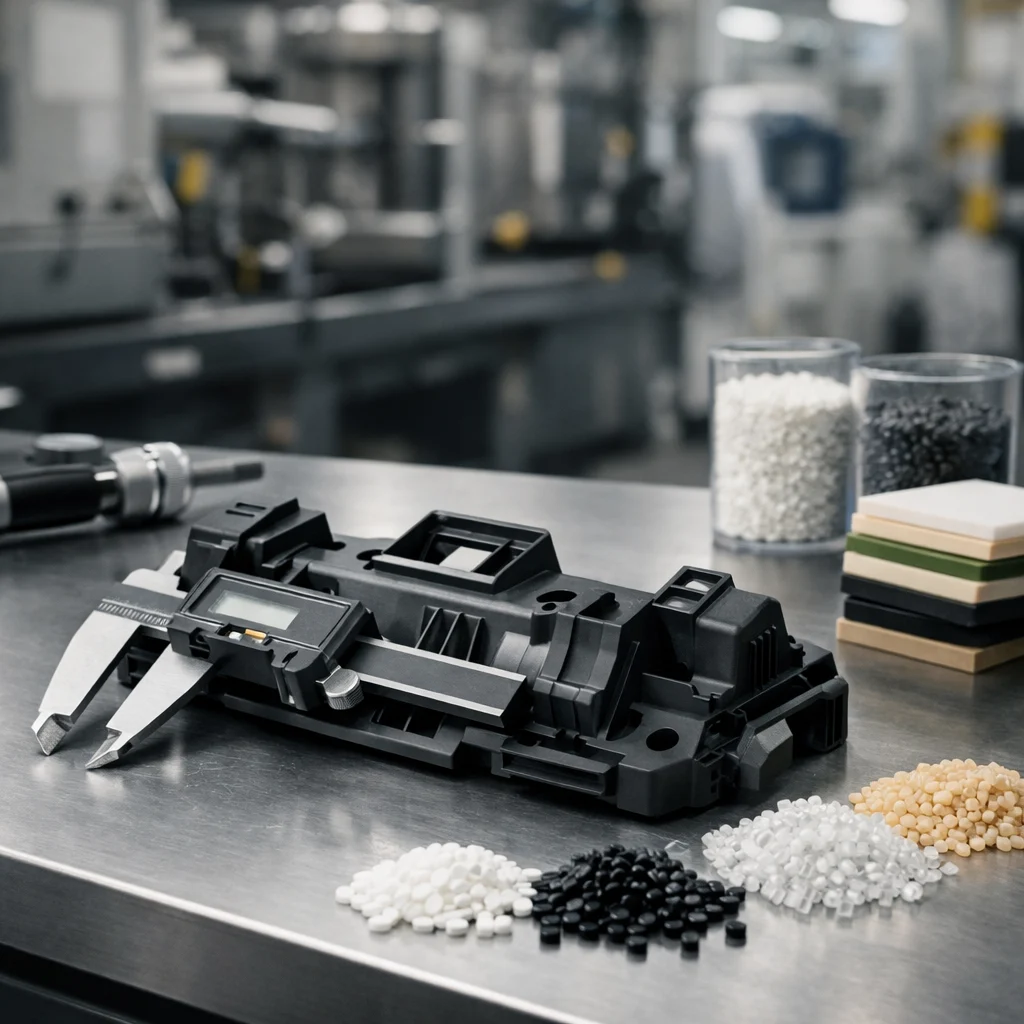
Design for injection molding is where good ideas either become efficient, repeatable products or expensive problems. The difference usually comes down to how well a part is designed before it ever reaches the mold.
For manufacturers, engineers, and product teams, understanding tolerances, material selection, and cost-driven design decisions early can significantly reduce tooling revisions, shorten production timelines, and improve part consistency. This article breaks down the most important considerations when designing parts for injection molding, with a focus on real-world production efficiency.
Why injection molding design matters
Injection molding is highly scalable, but it is also unforgiving. Small design oversights can lead to warped parts, sink marks, dimensional inconsistencies, or molds that require costly rework.
A well-designed part:
- Fills evenly and cools consistently
- Maintains predictable tolerances
- Minimizes material usage without sacrificing strength
- Reduces cycle time and scrap rates
That translates directly into lower per-part cost and smoother long-term production.
Understanding tolerances in injection molding
Tolerances in injection molding are influenced by material behavior, mold design, wall thickness, and cooling rates. Unlike CNC machining, plastic parts shrink as they cool, and that shrinkage must be accounted for during design.
Key tolerance principles:
- Uniform wall thickness improves dimensional stability
- Thicker sections cool slower and are more prone to warping
- Tight tolerances increase tooling complexity and cost
- Functional tolerances should be prioritized over cosmetic ones
In many cases, loosening a tolerance slightly, where function allows, can dramatically reduce tooling cost and improve yield without affecting performance.
Material selection and its impact on design
Material choice affects everything from part strength to surface finish to cycle time. Each plastic behaves differently under heat and pressure, which directly impacts mold design and achievable tolerances.
Common material considerations include:
- ABS for balanced strength, impact resistance, and cost
- Polycarbonate for high strength and heat resistance
- Nylon for durability and wear resistance
- Polypropylene for flexibility and chemical resistance
Filled materials, such as glass-fiber reinforced plastics, increase strength but also increase shrink variability and tool wear. Designing with the material in mind from the beginning avoids costly redesigns later.
Designing wall thickness for strength and efficiency
One of the most common design mistakes is uneven or excessive wall thickness. Thick sections increase cycle time and raise the risk of sink marks and internal stress.
Best practices include:
- Maintain consistent wall thickness whenever possible
- Use ribs and gussets instead of thick solid sections
- Gradually transition between wall thicknesses
- Avoid sharp internal corners, use radii to improve flow
Smart wall design reduces material usage while maintaining structural integrity.
Cost optimization through smart design
Cost optimization in injection molding is rarely about cutting corners. It’s about designing parts that mold efficiently and predictably at scale.
Design choices that lower cost include:
- Reducing unnecessary undercuts
- Designing for straight-pull molds when possible
- Minimizing part complexity
- Designing parts that eject cleanly without secondary operations
Each additional mold action or post-processing step increases cycle time and labor cost. Design simplicity pays off over the life of a production run.
Designing for manufacturability from day one
The most successful injection molded parts are designed with manufacturing in mind from the start. Collaboration between designers and molders early in the process often uncovers small changes that prevent major issues later.
Design for manufacturability focuses on:
- Predictable mold filling
- Efficient cooling
- Stable ejection
- Long mold life
This approach reduces lead times, improves consistency, and lowers total production cost.
Final thoughts
Injection molding rewards good planning. Thoughtful design decisions around tolerances, materials, and geometry lead to better parts, fewer revisions, and more reliable production.
For companies preparing to scale manufacturing or refine an existing product, investing time in design for injection molding is one of the highest-return decisions you can make.
If you’re evaluating a design or planning a new mold, working with an experienced injection molding partner early can help turn a concept into a cost-effective, production-ready solution.
Frequently Asked Questions
Questions and Answers